Goldman and Morgan Stanley to Each Earn $100M in SpaceX IPO Fees
The two Wall Street giants will split a $200M slice of a $500M total fee pool from SpaceX's $75 billion IPO.
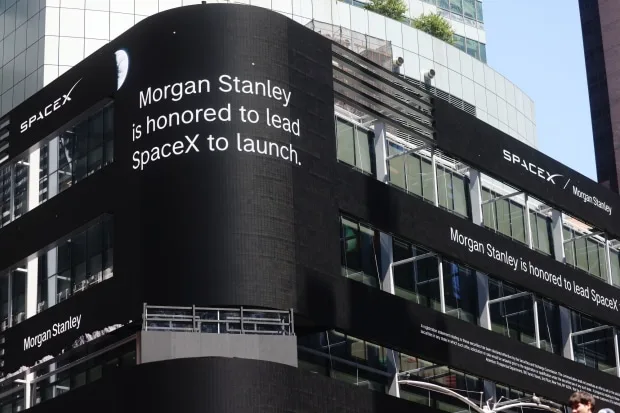
When a deal reaches the scale of SpaceX's initial public offering, the economics of Wall Street's fee machinery become starkly visible. Goldman Sachs and Morgan Stanley are each expected to pocket roughly $100 million from the offering, together accounting for two-fifths of the $500 million total fee pool that the $75 billion IPO generated — a payout that underscores just how consequential lead-underwriter positioning can be on a marquee transaction.
The remaining $300 million will be distributed among a broader syndicate that includes Bank of America, Citigroup, and JPMorgan Chase, each receiving substantial cuts, alongside a tier of smaller participants earning lesser sums. The tiered structure is standard practice for mega-IPOs, where the banks that shoulder the most underwriting risk and relationship management typically command a disproportionate share of the economics.
Read more Church & Dwight Stock Sits Quiet With No Fresh Catalysts →
For Goldman and Morgan Stanley, the windfall arrives at a moment when investment banking revenue has been under pressure across the industry, making a single deal of this magnitude strategically significant beyond just the immediate income. A $100 million fee from one transaction can meaningfully move the needle on a quarterly earnings report and reinforce a bank's reputation as the go-to advisor for high-profile tech and aerospace listings.
The SpaceX deal also illustrates how elite private companies, by staying out of public markets longer than predecessors of a similar profile, can concentrate enormous fee-generating events into a single moment — rewarding the banks that maintained relationships through years of private funding rounds. That dynamic has reshaped how Wall Street courts late-stage private companies, with banks sometimes offering favorable terms on lending or secondary-market transactions in hopes of securing a future IPO mandate.
Continue reading at WSJ.